
Just ask your agent
Claude Code, Cursor
Starts from zero each session: no record of what merged, what customers asked, what you decided.
Open source · a PM inside your coding agent
Nosy goes through your code, git history and rivals, and tells you what to build next. Every claim comes with its receipt.
Install NosySee the live sample
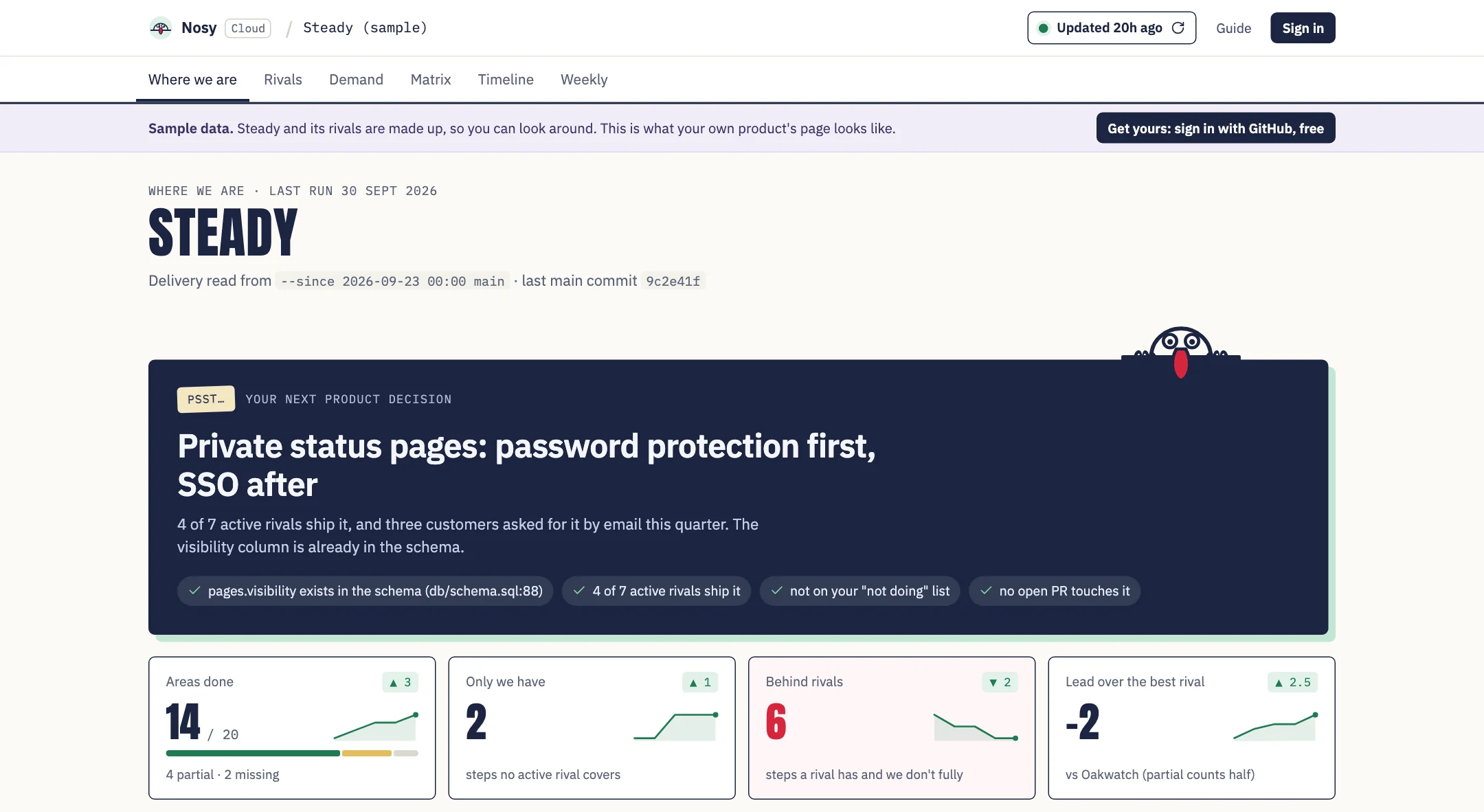
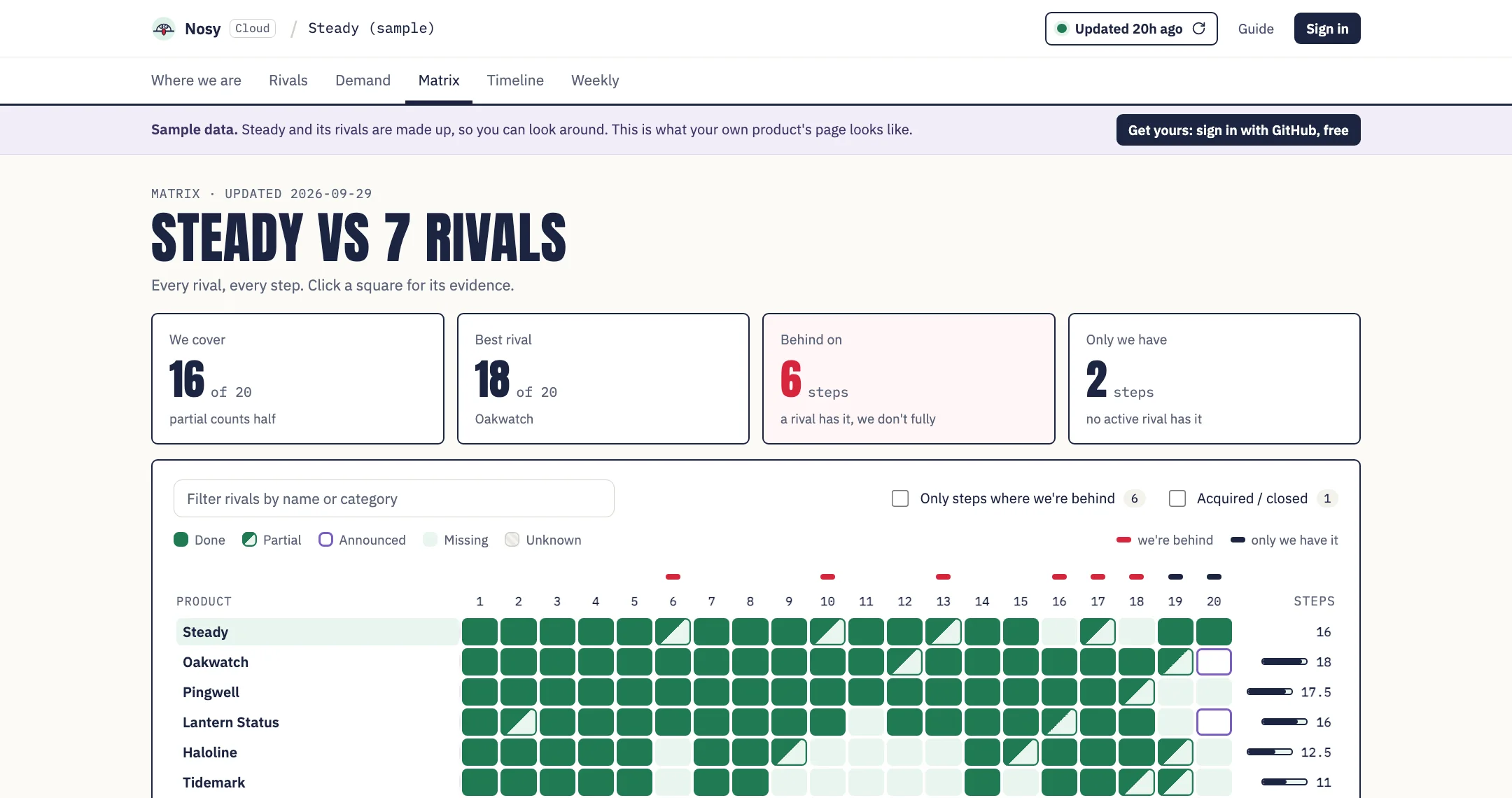
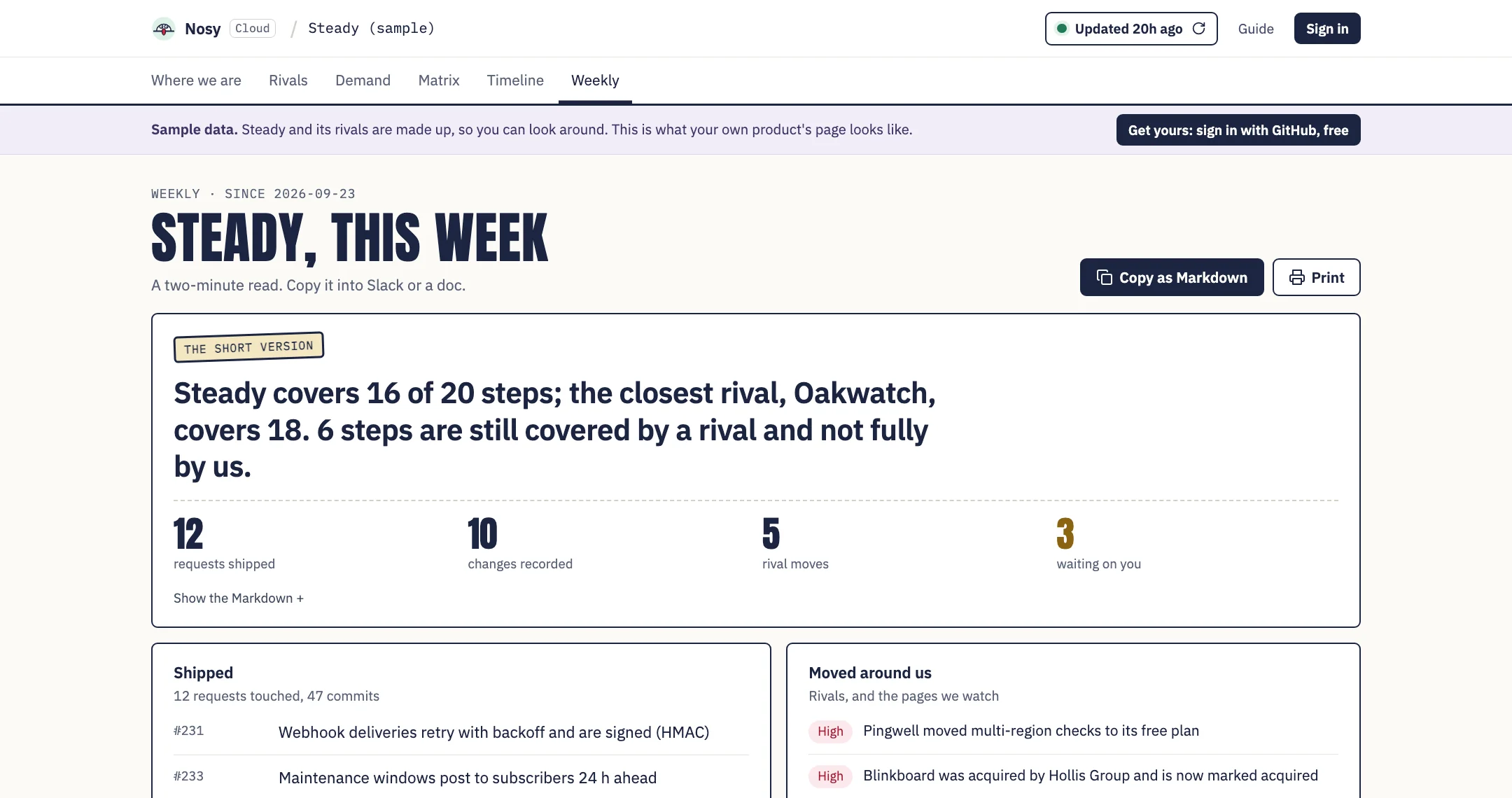
This is the product: a live dashboard for Steady, a made-up product. Click through it →
How it looks
Your code, git history and roadmap. What shipped, what’s half-built, what has no screen, and what only a person can do.
shippedpeekpsstoverheardfrontyarddresscodetodo
What rivals shipped, what their users ask for and whether they are growing, only as a reason to act. A public source for every claim.
neighborsrival-demandrival-signals
“We can do this.” Sized, placed in a wave, with a PRD your agents build from.
canwespillscooproadmaptea
A real question · chatwoot/chatwoot · 30 Sep 2026
You ask your agent
Can we retry failed webhooks?
Nosy hands it three things
Real output · nosy canwe
$ nosy canwe "retry failed webhooks"

In the code:
app/jobs/agent_bots/webhook_job.rb:3
  retry_on Webhooks::Trigger::RetryableError,
  wait: 3.seconds, attempts: 3
lib/webhooks/trigger.rb:3
  RETRYABLE_AGENT_BOT_STATUSES = [429, 500].freeze

Size from history: S · confidence: medium
It counts, it doesn’t guess · 28 Sep 2026, public issues and PRs, last 90 days on metabase/metabase
Real output, lines trimmed. Full run, and what it got wrong · how we tested it, including where it lost
Real runs on public products
Every figure re-read from its source on the snapshot date. All case studies
House rules
Shipped only when a PR, commit or issue says so.
Every claim carries a receipt: commit, file:line, URL, date.
A rival’s blog post isn’t a feature.
Small numbers aren’t trends. Incomplete counts are withheld.
Never a comment on style, bugs or quality.
Code, git, issue and PR text, public pages. No customer systems.
Commands
/nosy:nosySuggests the 2–3 commands worth running now.
/nosy:move-inLearns your product and roadmap. Run once.
/nosy:tourThe first look in one go: what Nosy reads, then one list of questions.
/nosy:shippedWhat reached your main branch, and why.
/nosy:peekWhat shipped, what didn’t, what has no screen.
/nosy:psstWhat you could ship today.
/nosy:canwe“Can we do X?” Answered with a size.
/nosy:neighborsWhat rivals shipped, and how much you already have.
/nosy:scoopThe roadmap, in waves.
/nosy:roadmapNow, Next and Later as a pull request on your ROADMAP.md.
/nosy:stakeoutThe whole weekly loop.
21 commands in all. Most have a terminal twin that runs with no model.
Nosy Cloud · free for now
The plugin writes a pm/ folder in your repo. Cloud turns it into a page your whole team can open, without installing anything.
Your next decision, four numbers with their trend, where you stand against every rival, the matrix and the timeline. A Demand tab puts what customers ask for next to whether you have it and how many rivals do. One battlecard per rival, copyable as Markdown.
A Rivals tab shows which public rival pages changed and what the users of your open-source rivals ask for, by votes. Cloud checks the public pages on a schedule; titles and links only, never people.
Every finding ends in a ready prompt for your own AI agent, built only from the numbers on the page. Connect the remote MCP server and your agent can read and search what you published.
The Weekly opens with one plain sentence written from the page’s numbers, each decision gets a line on why it matters and later on whether it worked, and Jev, a small decision model, rates how much each change matters. A line a model wrote says so and has a “Wrong?” button.
The page shows how old it is. Copy the refresh prompt, your agent runs the weekly loop and publishes, and the page tells you when the new numbers land.
Add teammates by GitHub username or a 7-day invite link. Members can view; only you publish, share or delete. A one-page Weekly to read or paste into Slack.
Your code, history and documents stay on your machine until you run nosy publish. The one call you didn’t start yourself is a once-a-day read of a public version file, off with NOSY_NO_UPDATE_CHECK=1. Only a fixed list of named report files is accepted, never your decisions file. Commit subjects, author names, branch names, your own issue titles and quotes are removed first, and a scan blocks secrets and personal data it recognises. --dry-run shows what would go.
No chatbot on our side: your own agent does the thinking. Two small models run on Cloud, Jev to rate a change and a writer for one sentence from the page's numbers; every such sentence says a model wrote it, and prompts go only to providers that do not keep them. How Cloud works.
Install
$ /plugin marketplace add nosy-hq/nosy
$ /plugin install nosy@nosy
Terminal, desktop app, VS Code, JetBrains. Send the two commands one at a time.
/nosy:nosy Answers with the 2–3 commands worth running now. Plugin commands are always /nosy:<command>.npx github:nosy-hq/nosy doctor --check Checks Node, git, gh, the skill files and hooks; prints the fix for each problem./nosy:doctor Renames files from an older Nosy./plugin uninstall nosy@nosy Your pm/ folder stays; it’s yours.$ npx github:nosy-hq/nosy install
One command for Claude Code, Codex, Cursor, Gemini CLI, Copilot, OpenCode and Kiro: it finds the ones your project uses and copies the skill folder into each. Windsurf, Roo, Junie: copy the skill folder by hand, or with npx skills add nosy-hq/nosy.
/nosy Codex: $nosy. Or ask “Nosy, psst”.npx github:nosy-hq/nosy doctor --check Checks Node, git, gh, the skill files and hooks; prints the fix for each problem.npx github:nosy-hq/nosy doctor Renames files from an older Nosy.npx github:nosy-hq/nosy uninstall Removes only the skill folders it wrote. Your pm/ folder stays; it’s yours.$ npx github:nosy-hq/nosy mcp
Any MCP client: Claude Desktop, Cursor, Zed, VS Code. Runs as a stdio server.
remove the nosy entry From your MCP client’s config.$ - uses: nosy-hq/nosy@main
Weekly, no model key, free. Can post the weekly "Psst…" to Slack or Discord. It commits pm/state only if you set commit: "true".
delete the step From your workflow file.$ npx github:nosy-hq/nosy weekly
No agent at all. The counting runs without a model.
nothing to remove It runs from npx and writes to your pm/ folder, which stays.We peeked over the fence · 43 products
Claude Code, Cursor
Starts from zero each session: no record of what merged, what customers asked, what you decided.
Unblocked, DeepWiki, Dosu
A map, not a verdict: no size, no roadmap slot.
Spec Kit, Kiro, Taskmaster, CCPM
Start after the decision. They don’t inventory what’s built or what rivals shipped.
Productboard Spark, Linear
Seats, and they read tickets, not what reached the branch.
Crayon, Klue, Kompyte
Rival monitoring by quote, blind to your own code.
free, MIT, in your agent
Inside first, then over the fence, then ahead. The record lives in your repo.
Nosy was here.
Public docs, Sep 2026. Our own column is scored by us.
When to skip it
| Nosy is not… | So |
|---|---|
| A code reviewer | Never comments on style, bugs or quality. |
| A competitor tracker | No alerts or dashboards. Rivals are one input, checked second. |
| A reader of customer data | No connector to customer systems. It reads code, git, issue and PR text, public pages. |
| Useful without a git repo | Its record comes from git and issues. A very young repo gets “sample too small”. |
| Something that acts alone | It suggests and sizes; you decide. It never pushes or posts unless you ask. |
Before you install
Your agent reads today’s code. Nosy adds what a session can’t hold: what merged and why, demand counted from issues, the rival matrix with sources, and last week’s answers.
Nothing of yours on its own. Nosy reads your code, git and GitHub issues and PRs (through your own gh) and writes to pm/. No telemetry. Once a day the plugin reads a public version file to tell you when a newer Nosy is out (off with NOSY_NO_UPDATE_CHECK=1). The full list is in docs/DATA.md on GitHub.
In Claude Code, four small hooks: an opening summary, a note after each commit, a never-rule check and a reference check. Each has an off switch (docs/INSTALL.md).
The plugin is free and MIT. Nosy Cloud (cloud.nosy.sh) is live and free for now: a shared record for your team. It never changes what the plugin does. Tokens depend on your repo’s size; the counting scripts run without a model.
Run npx github:nosy-hq/nosy doctor --check and it prints the fix. To uninstall: /plugin uninstall nosy@nosy, or npx github:nosy-hq/nosy uninstall. Your pm/ folder stays.